
Honoring his legacy
Dr. Clarence B. Jones
1931 – 2026
Who WAS dr. clarence b. Jones?
The night before the March on Washington, Clarence B. Jones wrote out several pages longhand on legal paper, wrapped them in a magazine, and handed them to Martin Luther King Jr. in an elevator at the Willard Hotel in Washington, D.C. He stood fifteen feet behind King the next morning on the steps of the Lincoln Memorial as King spoke his words to the world.
He is the last living architect of the I Have a Dream speech.
But Clarence Jones was more than that moment — extraordinary as it was. He was Dr. King's personal attorney, trusted adviser, and one of his closest friends through the most dangerous years of the civil rights movement. He counseled courage. He helped leaders say what they needed to say, when the stakes could not have been higher. He was a communicator before the title existed — long before anyone had invented the role.
He had attended Juilliard to study music. He understood that words are musical notes — that the rise and fall of a sentence is a form of composition. He brought that ear to everything he wrote.
He went on to a life of continued service — as author, scholar, teacher, and advocate. He wrote What Would Martin Say?, Behind the Dream, and Last of the Lions, his memoir. He co-founded the Institute for Nonviolence and Social Justice at the University of San Francisco. He received the Presidential Medal of Freedom. He never stopped trying.
Clarence described his own life as a bridge from one America to another — spanning poverty and prosperity, injustice and acceptance, Harlem and Wall Street. He suffered the iniquities, fought the battles, and lived to see both the fruits of his labor and its failings. And he kept going.
HIS RELATIONSHIP WITH THE COMMUNICATIONS NETWORK
Clarence B. Jones was a member of The Communications Network's advisory board and a beloved presence at our annual conference for many years.
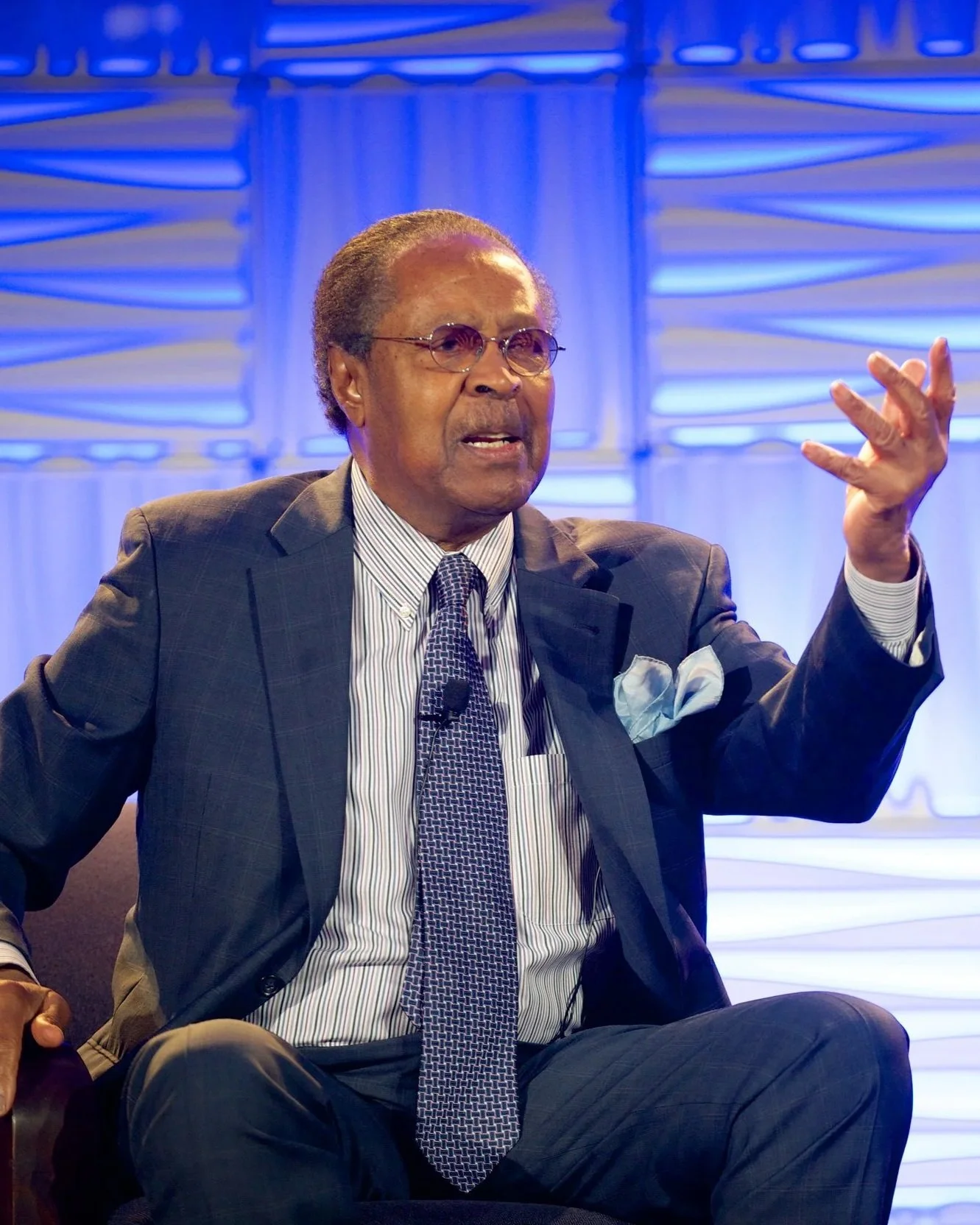
He first joined our community at ComNet15 in San Diego, where he sat down with journalist Jonathan Capehart for a conversation that brought the house down. He told that room: "There is no way in hell you can be risk averse if you're serious about making a difference." Nobody forgot it.
He came back year after year — different cities, always the same grace — to present the award that bears his name.
In 2018, his voice shaped one of the most important decisions this organization has ever made. When hotel workers went on strike before ComNet18 in San Francisco, Clarence was clear: he would not cross a picket line. Those words landed. The Network moved the conference. It started with his voice.
In June 2020, during the pandemic and the uprising following George Floyd's murder, he sat with hundreds of Network members on a virtual call and spoke with honesty and love about where the country was and what communicators owed it. He reminded us that communications shares a root with community. He said it is a form of protest to walk into the world with hope. And he ended with the words he lived by: if not us, who? If not now, when?
THE AWARD
The Clarence B. Jones Impact Award is given each year to honor communications work that moved people to act — work that carries the conviction that the right words, delivered with courage and clarity, can still change the direction of history.
It is not a tribute. It is a continuation.
